
Guide to Hydraulic Car Lift Dimensions & Installation

hydraulic car lift

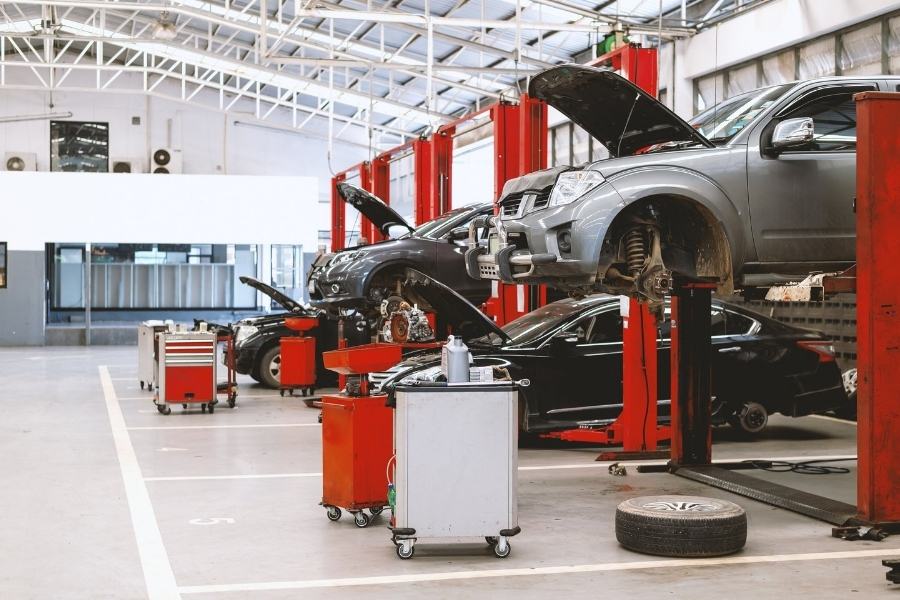
Hydraulic car lifts are an essential component in any auto repair shop. These versatile devices come in multiple sizes and dimensions, making it easy for you to find the make and model that best meets your needs and budget.

What is a Hydraulic Car Lift?

A hydraulic car lift is any car lift powered by hydraulic fluid. These lifts were first invented in 1925 and subsequently modified and updated as new technology enabled lift manufacturers to improve the original design.

What Are the Common Hydraulic Car Lift Dimensions?

Hydraulic car lift dimensions vary depending on the lift make and model you pick for your shop. Car lift dimensions for smaller lift models tend to be between 108 and 148.5 inches high and about 132 inches wide. Arm length ranges from 680 to 1,300 mm and the distance between the columns is about 102 inches. These lifts tend to require a minimum ceiling height of 12 feet. Larger models, on the other hand, can be up to 200 inches long and have a column height of about 88 inches. The width between the posts is about 100.2 inches.

How Many Types of Car Lifts Are There?

There are about nine different types of car lifts, but some are far more common than others. The lifts typically used in most car repair shops are two-post, four-post, and scissor lifts.

Two Post

Two-post car lifts are easy to install and only require minimal maintenance. They’re ideal for working on cars, SUVs, and light trucks as they allow mechanics to access the vehicle’s undercarriage, engine, body, and wheels with ease.

Four Post

Four-post car lifts can hold more weight than two-post car lift models. This makes them ideal for auto repair shops that service commercial vehicles. These sturdy lifts work well for undercarriage work, engine work, and bodywork. They can also be used for jobs such as wheel alignment and tire changes if you have a rolling jack or alignment kit to go with the lift.

Scissor Lift

Scissor lifts get their name from the X-shaped steel structures that enable the lift to raise or lower a vehicle. These lifts can be used to work on both personal and commercial vehicles. Most scissor lifts are fixed to the garage floor to keep vehicles stable, but some models are portable, allowing car shop owners to move the lift around or even out of the shop.

What to Know Before Installing a Hydraulic Car Lift

One of the first things you need to know before installing a hydraulic car lift is the amount of space you need for the job. Check the hydraulic car lift dimensions before finalizing the purchase. Additionally, bear in mind that you need not only space to fit the lift but also space for mechanics to walk around a vehicle on the lift. You’ll also want to know how the lift works, the type of care and maintenance it needs, and where to find reliable replacement parts.

How Much Space Do You Need for a Car Lift?

You’ll want at least two feet of extra space around a car lift to allow workers to repair vehicles. Additionally, you should have at least one foot of ceiling space once a vehicle is placed on a lift and raised. There should be no fans or light fixtures in this additional space to prevent accidents and/or damage to customer vehicles. Allow about six feet of space under a lift to enable mechanics to work comfortably under the vehicle.

Steps for Installing a Car Lift

The first step in installing a car lift is to prepare your shop for lift installation. Check your concrete flooring; it should be at least four inches thick to hold the weight of a lift. Read the owner’s manual for your lift and make sure you have all the tools you need for the job. Finally, choose a spot for lift installation that meets your needs and the lift’s specifications. Consider both your current and long-term needs to make sure the lift will serve you well for the foreseeable future.

Hydraulic Car Lift Installation Tips

Start by anchoring the lift to the floor. Make sure the anchors are secure and then assemble the lift components. Finally, install the cables, lines, hoses, and arms. Test your lift before you start using it to make sure everything is in good working order.

Consider Lift Height and Width

Your owner’s manual will tell you the height and width of your lift model. However, you also have to consider how high the lift can raise certain vehicles. When in doubt, measure the vehicle’s height to make sure you can raise it completely off the ground. Width is yet another important factor to consider, as you may need to use multiple tools to repair or renovate a vehicle, and you’ll want ample space for the job.

Invest in High-Quality Car Lift and Safety Parts

A car lift can last between fifteen and twenty years. This is especially true if you install the lift properly and maintain it in accordance with the instructions in the owner’s manual. Buying high-quality lift and safety parts also plays an important role in proper maintenance, as the right part won’t put a strain on the lift and will allow you to operate the device without problems.

Follow a Budget

Set aside some money each month to repair and replace lift parts. Once a year, you should switch hydraulic hoses, rollers, cables, chains, and sheaves. Hydraulic cylinders and the motor should be replaced as needed. If the car lift can’t be raised or lowered properly, you may need to replace the air latch cylinder, cable latch, and/or air switch.

SVI International Has the Hydraulic Car Lift Parts You Need

SVI stocks tens of thousands of top-tier parts for multiple range lift models. These include truck and bus lifts, specialty lifts and cylinder products, and hydraulic tubing and fittings. We offer same-day shipping to make it easy for you to get needed parts without delay. Get in touch with us to get price quotes and place an order.
Guide to Wheel Torque Specs for Lug Nuts and Bolts

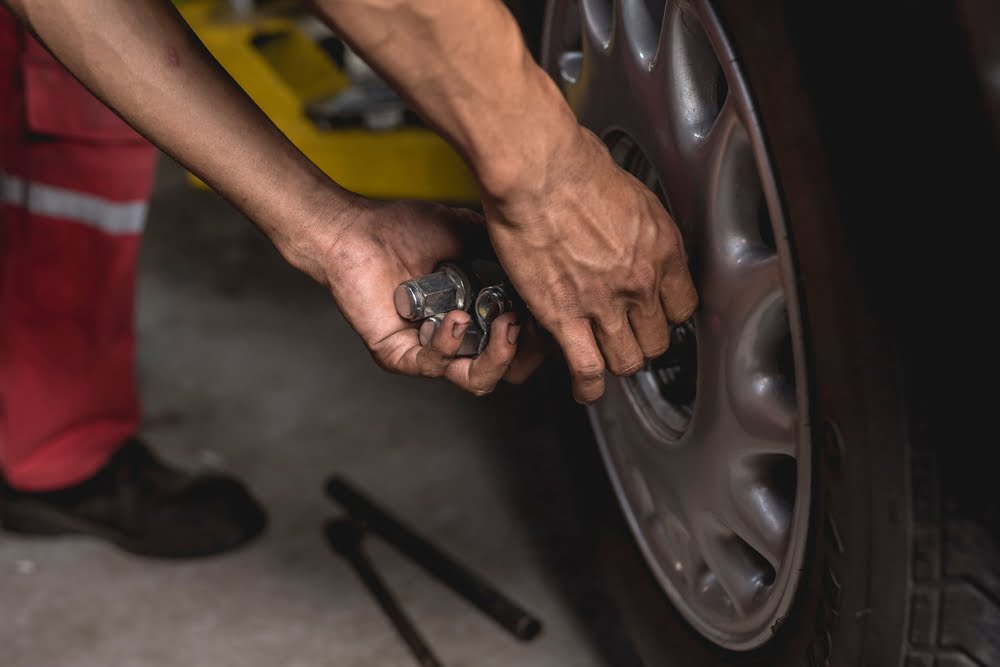
mechanic screws on lug nuts onto the tire of a serviced car

Lug nuts and bolts are pretty small. They’re not one of the seven main parts of a tire, and it’s easy to give them little or no thought unless you need to change a flat. However, these small components play an integral role in determining wheel torque, which in turn determines how fast your car drives and the longevity of your tires.

What is Wheel Torque?

Wheel torque is the measurement used to determine the tightness of vehicle wheel lug nuts. The measurement used is called foot-pounds and the higher the foot-pounds, the more weight your wheels can hold and the faster the vehicle can move.

How To Check Wheel Torque

To check wheel torque, start by lifting the vehicle with a jack. Then, use an impact gun, power impact wrench, or torque stick to remove the lug nuts from the wheel. Afterward, manually reattach each lug nut by hand. Finally, use a manual torque wrench to tighten the nuts according to the lug nut torque specifications in the vehicle’s owner’s manual. Keep in mind that lug nuts must be removed and replaced in a specific pattern, not randomly. Listen for a distinctive “click” sound to confirm that each lug nut has reached the correct torque.

Why Follow a Specific Pattern?

The lug nuts keep the tired balanced and even. Thus, they need to be removed and tightened in a specific pattern to prevent tire wear and/or uneven stress distribution.

Proper Tightening and Loosening Pattern for Lug Nuts

Following are instructions for removing nuts with a four-, five-, six-, and eight-lug pattern. The same pattern should also be used when tightening nuts.

4-Lug Bolt Pattern

When loosening a tire with four lug nuts, start with the top bolt. Second, remove the bottom bolt. Next, remove the bolt on your left. Finally, remove the bolt on your right.

5-Lug Bolt Pattern

A wheel with a five-lug bolt pattern will have one lug nut on top, two on the bottom, and one on either side. Start by removing the lug nut on the top. Next, remove the nut on the bottom left. The third lug nut to remove is the one on the right side. The fourth nut you’ll remove is the nut on the left side. Finally, remove the nut on the bottom right.

6-Lug Bolt Pattern

A wheel with a six-lug bolt pattern will have one nut on the top, one nut on the bottom, two nuts on the left, and two nuts on the right. Once again, you’ll start by removing the top lug nut. Next, remove the bottom nut. Next, remove the top left nut. The fourth nut to remove is the one on the bottom right. The fifth nut to remove is the one on the bottom left. Finally, remove the top right nut.

8-Lug Bolt Pattern

This pattern will have a top nut, a bottom nut, and three nuts on each side. First, remove the top nut. Then, remove the bottom nut. The third nut to remove is the one on the top right. The fourth nut to remove is the one on the bottom left. Next, remove the nut on the far right, before removing the nut on the far left. The seventh nut to remove is the one on the bottom right. Finally, remove the bolt on the top left side.

Always Follow the Manufacturer’s Specifications

While there are general guidelines you should follow when checking and adjusting torque, it’s wise to always read and follow the manufacturer’s specifications. There are scores of models on the market and the way you check and repair one vehicle may not be the best way to handle the next vehicle. Checking manufacturer specifications can save you a lot of time and hard work. It can also protect you from liability if the car is involved in a vehicular accident.

Using a Calibrated Torque Wrench

A calibrated torque wrench will enable you to accurately measure torque and ensure bolts on the vehicle are neither too tight nor too loose. For optimal performance and to meet industry standards, the torque wrench should be calibrated once a year or every five thousand cycles, whichever comes first. Naturally, like all other tire machine parts, a torque wrench would need to be replaced if it becomes too old or sustains damage that can’t be repaired by an expert. Signs you need a new torque wrench include a broken square drive, bent barrel, and damage to the wrench’s indexing.

Recommended Torque Range

Lug nut torque specs typically range from 75 to 100 ft-lb for most vehicles. However, it’s important to check the owner’s manual for specific instructions. What’s more, bear in mind that tire size can also affect recommended torque, as putting large tires on a vehicle with a small engine can significantly increase its torque.

What Happens if You Under- or Over-Tighten?

Lug nuts must be tightened just right. Under-tightening can result in the wheels coming loose on the road, which could cause a bad accident. Over-tightening the nuts can damage the wheel and/or the threats on the nuts.

SVI: Leading Parts Provider for Auto Equipment

Every automotive repair shop needs reliable tools and fast access to a wide selection of automotive parts and automotive tool parts in order to properly serve its customers. That’s why SVI offers more than 40,000 products to meet the needs of automotive shop owners throughout the United States. What’s more, our two ready-ship warehouses offer fast shipping to ensure that needed parts and machinery reach you without undue delay. Get in touch with us to learn more about our products and services, or to request a custom price quote on specific products.

High-Quality Tire Changer Machine Repair Parts

High-quality, durable tire changing repair machines are crucial components to garages and automotive service stations.

High-volume service is demanding, and most auto shops do not have the resources to continually purchase new equipment. Thus, selecting a high-quality tire changer machine initially can lead to increased productivity and cost savings – and finding a repair parts resource for these excellent machines provides lasting value.

What Makes SVI’s Tire Changer Repair Parts Unique?

SVI International, Inc delivers an extensive variety of repair parts, built for quality and durability. The following content explores the range of repair parts SVI offers for many tire changer machines brands – including a brief summary of each make and model.

While exploring the following content, you may wish to search for your specific tire changer model – specific model numbers will be listed throughout this piece; a search and find may guide you to the exact part you require efficiently.

What Repair Parts Does SVI Offer?

ACCU Industries

SVI provides repair parts for a number of Accu Industries tire changer machines, including:

  • 320 S
  • 326 S
  • 3390
  • 3400
  • 3402
  • 3450
  • 3501
  • 3602
  • 3650
  • 4401
  • 4402
  • 4501
  • 4502
  • 526T
  • 5402
  • 5602
  • 5802 HP

The number one source for Accu-Turn Tire Changers, SVI supplies mount/ demount heads, bead breaker seal kits, quick-release dump valves, bead air blast control valves, tire iron bead levers, drop center tool plies, and a number of other parts. In short, SVI has what you need. View our entire collection of Accu Industries repair parts.

Hunter

Hunter Engineering Company has been engineering equipment since 1946, with a reputation for visionary leadership. SVI International supports and supplies the very best products; thus, SVI provides repair parts for an extensive variety of Hunter tire changers. These include:

  • Auto34
  • TC3000
  • TC3100
  • TC3250
  • TC3500
  • TC3500SS
  • TC3700
  • TCA34
  • TCX500
  • TCX550
  • TCX575

Teco

SVI provides parts for ten varieties of Teco tire changers:

  • BPS
  • SPH
  • Teco 21, 27, 36, 46, & 48
  • TPH
  • UPH

Snap-On

Snap-On is known for a wide variety of useful products for a variety of applications, from auto repair shops to personal garages. Among these include tire changer products. Of course, SVI provides repair parts for an extensive Snap-On inventory, including (but not limited to):

  • EEWH300A
  • EEWH302A
  • EEWH303A
  • EEWH304A
  • EEWH305A
  • EEWH305B
  • EEWH306A
  • EEWH307B
  • EEWH310A
  • EEWH311A
  • EEWH312A3
  • EEWH315A
  • EEWH317A

Simpasfaip/ Faip

SVI provides a plethora of repair parts for two specific tire changer makes:

  • M 928
  • M 928 ROYAL

Silverline

Silverline provides excellent tire changer equipment for light-duty applications. SVI International provides repair parts for the Tire Changer, Silverline, SL11.

Sice

Founded in 1964, Sice is a well-known manufacturer of tire changers, wheel balancers, wheel alignment systems, and a variety of other tire servicing equipment around the world. Operate with a Sice tire changer? SVI carries repair parts for a variety of models:

  • M380
  • P350
  • PT 100
  • PT 98
  • S390
  • S408
  • S408 GP
  • S408 Maxi
  • S412
  • S415
  • S419
  • S425
  • S432
  • S435
  • S436

Sicam

Sicam is poised to be an industry leader in manufacturing high-quality products, including tire changers. SVI International carries parts for the following Sicam tire changer machine models:

  • COLIBRI BL 502
  • Falco AL508
  • Falco AL510
  • Falco AL518
  • Falco AL520
  • Falco NA524
  • Falco NA526
  • JUMBO TCS 26
  • NIBBIO EL 400

Ravaglioli

Not to be confused with the pasta, Ravaglioli is a top-ranking company in the garage equipment industry. Established in 1958, Ravaglioli has dedicated years to developing a great product – over 350,000 of them. SVI International carries repair parts for a broad spectrum of Ravaglioli tire changers:

  • G7246ID
  • G7645
  • G7645D
  • G76451
  • G7645OD
  • G7645IT
  • G7645ITD
  • G7645ITV
  • G7645IV
  • G7645V
  • G83RA

Ranger

SVI International distributes excellent repair parts for the following Ranger tire changers, including (but not limited to):

  • R23
  • R23AT
  • R23LT
  • R23ST
  • R26AT
  • R26DT
  • R26EX
  • R26ST
  • R30XLT
  • R710
  • R745

Nussbaum

When you need to repair your Nussbaum tire changer machine, SVI International has every repair part you may require. Nussbaum’s primary tire changer machine model is TC 355.

Mondolfo Ferro

SVI International carries repair parts for two Mondolfo Ferro tire changers: AS 912 TI and AS 914 TI.

Launch

Like Mondolfo Ferro, Launch produces two primary tire changer machines, both with readily available repair parts at SVI – the two machines are TWC-481 and TWC-581.

Kwik-Way

Kwik-Way manufactures a broad expanse of auto equipment, including parts washers, cylinder hones, brake lathes, seat grinders, surface grinders, and – of course – tire changers. SVI has a collection of repair parts for the following models:

  • 502T
  • 530
  • 540
  • 545 Extreme XL
  • 580
  • 584

John Bean

John Bean heavy-duty tire changers are built to hand any type of wheel, including trucks, buses, earthmoving machines, and agricultural vehicles. Purchasing a brand-new tire changer for your specific application can be costly and, ultimately, unnecessary. SVI carries repair parts for:

  • 7600
  • 7700
  • 8931
  • 8936
  • 8950INA
  • 8950INO
  • 8960INA
  • 8960INO
  • 8990 INO Electric

Hofmann

Hofmann, like many of the previously explored brands, carries many tire changer machines in extensive variety. SVI has repair parts for many of the varieties, including:

  • Easymont PT98
  • Geodyna 30-3
  • Geodyna 30-3TM
  • MH 310
  • MH 320PRO
  • Monty 1100
  • Monty 12.S
  • Monty 12SE
  • Monty 1510
  • Monty 1520
  • Monty 1550
  • Monty 1565

All Tool

All Tool provides two tire changer machines, All Tire 212 & All Tire Plus. SVI International carries extensive parts for both types.

Giuliano

Since 1976, Giuliano has been active in the creation and optimization of automotive equipment. They build their products with a passion for reliability and steady industry growth. SVI carries repair parts for eight Giuliano tire changers:

  • S 109 Bike
  • S224
  • S225
  • S232
  • S551
  • Silver 112
  • Silver 112F
  • The BOSS

SVI International, Inc

The list we have compiled above is only a fraction of the tire changer machine brands SVI International, Inc carries repair parts for. Other high-quality brands include Focus, Coats, Eagle, FMC, Fasep, Butler, Bear, Ammco, and Tuxedo.

At SVI International, Inc, we are the leader in repair parts for automotive and industrial equipment. With over 40,000 repair parts readily available for high-quality equipment. In addition to ever-day parts, SVI is known as a problem solver, innovative in every industry. We are a “Can-Do” company, dedicated to providing answers for industry issues.

Get in touch with us today at (800) 321-8173 or via our online contact form to learn how we can help you.

HOW LONG DO CAR LIFTS LAST?

A car lift is a big investment for car enthusiasts and automotive shops alike; so, it’s important to make sure a lift is a lasting investment. A wrong decision could put you out of a lot of money. That’s why it’s necessary to understand the typical lifespan of various car lifts as well as the knowledge of how to maintain your car lift so that it can last. After reading this article, you’ll have no trouble picking out a lift that can last and understanding how to maintain your lift—allowing you to rest easy that your investment will last!

EXPECTED LIFESPAN OF DIFFERENT TYPES OF CAR LIFTS

A car lift will be expensive for most, so it’s important to know how long different types of car lifts will last. Most car lifts can last a long time if they are maintained regularly, but some lifts can last longer than others. Let’s look at how long each type of car lift is expected to last.

There are four types of lifts that will be the most common for people looking to purchase a car lift. They are:

  • 2-post lifts
  • 4-post lifts
  • Scissor lifts
  • Portable lifts

Let’s take a closer look at these lifts and how long you can expect them to function properly.

2-POST AND 4-POST CAR LIFTS

The 2-Post and 4- Post car lifts are a staple in many automotive shops and can be found in particular car enthusiasts’ garages. They are similar enough in life span to be compared here. A 2-post or 4-post car lift that has been properly maintained last decades. Some buyers will even decide that it’s cheaper to find a used 2-post or 4-post lift for sale that’s 10 to 30 years old, and still a smart investment. The distinction that is truly important to make is whether a 2-post or 4-post car lift is graded as “commercial” or “enthusiasts.”

Commercial 2-post or 4-post lifts are designed to be used all day, every day, while car lifts that are graded as enthusiasts are not. If a commercial 2-post or 4-post lift is properly maintained, it should be able to last and function properly for a long time. However, the results are more varied with “enthusiast-grade” 2-post and 4-post lifts. While some enthusiasts’ lifts will be commercial grade, most are not. The problem with enthusiast lifts, is that most will use inferior hydraulics, cheaper cables, cheaper guide rollers, etc. An enthusiast-grade can last if it’s maintained, but the maintenance costs begin to outweigh the value. Lastly, let’s look at popular options for car enthusiasts and small garages.

SCISSOR LIFTS AND PORTABLE LIFTS

A garage or work area can often be too small to allow a 2-post or 4-post lift. This is where scissor lifts or portable lifts come in. While specific types of these lifts can be used commercially, typically, these are popular options for enthusiasts and beginners. As such, most entry-level hydraulic lifts, like scissor and portable lifts, are “enthusiast-grade” and not meant for commercial use. These lifts are usually recommended for use with very low weight ratings and come with light-duty components to try and have a lower price point for a beginner looking to take on small car repairs.

An entry-level or enthusiast-grade lift can be expected to perform just fine for the first 3-5 years of ownership, though they tend to have long-term problems. Some issues that you could run into are:

  • Entry-level and enthusiast graded lifts tend to have cheaper motors that have a higher risk of overheating. If this happens, you can expect the motor to start to degrade.
  • These types of car lifts often have low quality hydraulic fittings, hoses, and cylinders. After a few years, they can deteriorate, and replacing them can be costly if your manufacturer even makes replacements.
  • Beginner scissor lifts have multiple components that make them work—but since it has multiple components that lift both ends of the vehicle, one side can deteriorate faster than the other. This will end up costing you down the line or, at the very least— shorten the lifespan.

Now that you know the differences between various types of car lifts and the problems that can plague your lift, it’s time to look at what you can do to maintain your lift.

CAR LIFT MAINTENENCE

If you want your car lift to last, you’ll have to make sure to perform regular maintenance to keep your car lift running efficiently. Here are a few things you can do to keep up with your lift:

  • Be sure to lubricate posts with grease.
  • Review all arm adjusting locks to make sure they are functioning
  • Review all cables connections.
  • Inspect safeties for proper operation.
  • Look at your cable tension and adjust if necessary.

These are just a few of the things you can do to make sure your car lift continues to operate and to ensure it lasts if it possibly can. Now that you know the types of lifts available and how to maintain them, it’s time to purchase a car lift!

FIND THE RIGHT LIFT FOR YOUR OPERATION WITH SVI INTERNATIONAL

Whether you decide on an automotive scissor lift, a four-post lift, or any other lift model, it’s imperative that you purchase your lift and lift replacement parts from a highly reputable company. At SVI International, we are the industry’s leading supplier of auto lifts and lift repair parts for all types of automotive lifts.

With over 40,000 products, our diverse product line serves as a one-stop shop for equipment parts, lifting equipment, fluid delivery products, RELS brake lathes, and so much more.

We know that downtime can be costly, so our 3 ready-ship warehouses provide on-time delivery and same-day shipping for in-stock parts.

An SVI specialist would love to get in touch about serving your needs, including any questions or concerns you may have. To get in touch, give us a call at (800) 321-8173 or complete our online contact form. We always respond quickly!