What Size Car Lift Do You Need?

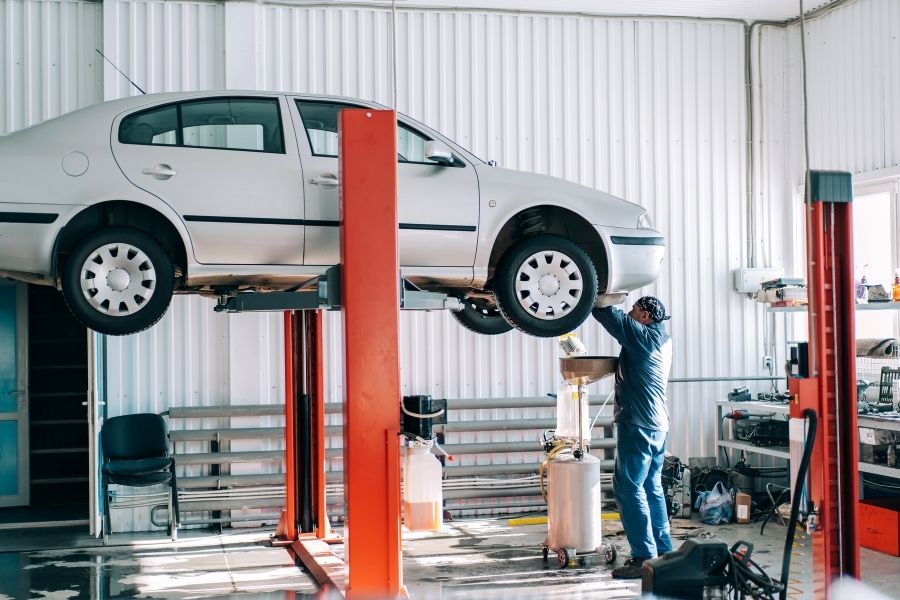
A car lift can be a big investment for hobbyists and businesses alike. Because of this, you want to make sure you get the right lift for your needs. There are a few things to consider when buying a lift, but few are as important as buying the correct size. The right “size” can mean multiple things. When considering what size car lift you need, you’ll need to consider if the lift will fit in your space and if it can support the weight of the type of vehicles you want to work on. Regardless of whether you’re in a home garage or a professional shop, these are a few things you will need to think about when determining what size lift you will need.

No one should purchase a car lift on impulse. By setting your goals and thoroughly measuring your space, you can establish what kind of car lift will best suit your needs. Once you ask yourself why you’re buying a car lift in the first place, you’ll be able to start answering the question: what size car lift do you need?

Determine Why You Are Purchasing a Car Lift

The first step is to determine why you’re purchasing a car lift in the first place. Are you looking to work on cars out of your garage or at an automotive shop? Whatever your reason, it is important to realize what types of vehicles you’ll be working on since a pick-up truck and a common compact car may require different car lifts.

Once you’ve decided what lift to purchase based on the vehicles you’ll be working on, it’s time to see which lift can accomplish your goals. To figure out which lift size you’ll need, you will have to calculate your ceiling height, floor space, and workspace for different-sized vehicles.

Figure Out Your Ceiling Height

Unlike car jacks, lifts will need plenty of vertical space to work with them. To figure out what type of car lift you can use, you will first need to determine your ceiling height. Typically, you will need at least a minimum of 11 or 12 feet, plus additional clearance for hazards and lights. Unfortunately, if you have low ceilings, your options are going to be limited. However, if your ceiling is higher than the minimum, then your options are essentially endless!

Since certain lifts are necessary to work on specific types of vehicles, your ceiling may make the choice of what vehicles you will be able to work on for you. If the height isn’t an issue, the next thing to consider is the amount of space you have in your garage or shop.

Calculate How Much Floor Space You Have

Assuming you’re not limited on height, start calculating how much floor space you have available to you before you make a purchase. To determine your amount of floor space, you will need to be realistic about the amount of open space, not just the overall square footage. Factor in any additional equipment that cannot be moved and deduct that from the total room size. Also, make sure to account for anything that might need to be moved to accommodate space for the car lift.

No matter what lift you purchase, you’ll want to make sure it can be installed properly. That’s why it’s important to make sure you measure the space you have available accurately, and as many times as necessary to avoid purchasing a lift that simply won’t fit. Once you’ve nailed down the amount of space you must work with, the last thing to do is to pick a lift based on the vehicles you want to work on, and what lifts can handle them.

Determining the Vehicles You Want to Lift

When you first decided to purchase a car lift, you likely had a certain vehicle in mind. Whether it was a truck or a compact car, you should now have a better impression of your options based on your available ceiling height and floor space. Different vehicles will work best on certain types of lifts based on the vehicle build and weight. On most vehicles, you can find a sticker located on the door jam to figure out how much a vehicle weighs and how the weight is distributed throughout. It’s also important to factor in some extra weight for vehicles that have extra attachments to the vehicle that could add on extra weight.

It is recommended you purchase a lift that can handle even heavier weight than your intended vehicle size to give yourself some wiggle room. If space is no longer a concern, this is the best option to consider when determining what size of car lift to purchase.

Ultimately, when purchasing a car lift, you want to get a slightly bigger lift than you will need. You want to rest easy knowing your car lift will be able to perform in the workspace you have available and be able to lift the weight of the vehicles you want to work on. The only thing left to do is to buy the lift!

Find the Right Lift for You Operation with SVI International

Whether you decide on an automotive scissor lift, a four-post lift, or any other lift model, it’s imperative that you purchase your lift and lift replacement parts from a highly reputable company. At SVI International, we are the industry’s leading supplier of auto lifts and lift repair parts for all types of automotive lifts.

With over 40,000 products, our diverse product line serves as a one-stop-shop for equipment parts, lifting equipment, fluid delivery products, RELS brake lathes, and so much more.

We know that downtime can be costly, so our 3 ready-ship warehouses provide on-time delivery and same-day shipping for in-stock parts.

An SVI specialist would love to get in touch about serving your needs, including any questions or concerns you may have. To get in touch, give us a call at (800) 321-8173 or complete our online contact form. We always respond quickly!

What’s the Difference Between Tire Balancing and Alignment

As a repair shop, when you tell a customer they need a tire balance and alignment, you already know the look they will give you.

It’s that “I’m going to pretend I know what you’re talking about” stares as the cogs in their brain engage, and they ask themselves why they need both or insist aloud that they don’t. The truth is that the average person probably thinks these two services are interchangeable. And few vehicle technicians take the time to explain why they’re not. It helps to have yourself and your team prepared to explain tire balancing vs alignment in terms non-experts will understand.

The content below explores tire balancing vs alignment in simple terms. We discuss strategies you can use to make sure they understand the benefits of both and should be willing to pay for them.

What is The Cause of Vehicle Vibration?

Anyone who has owned a car long enough knows it will start to vibrate eventually. From engine malfunction to a bad motor mount, there are many reasons for this. But we’re here to talk tire balancing vs alignment.

Unbalanced wheels are certainly a common culprit. The wheels that the tires are mounted vibrate as the wheel weights are no longer correctly distributing the weight. You can even turn the steering wheel to show these to your skeptical customer. At the same time, a misaligned suspension can contribute to uneven tire wear and vibrations, indicating the need for alignment.

What is Wheel Balancing

Tire balancing machine, showing the difference between tire balancing vs alignment

Tire balancing (or wheel balance) involves correcting the weight distribution on the tires. To do this, your highly skilled professionals use a specialized tire-spinning machine to calculate the weight distribution precisely. You can then install car weights to redistribute the weight.

If your customer neglects wheel balance, they are not only shortening the life of their tires. They also potentially damage the suspension that connects the tires to the vehicle and the drivetrain that delivers power to the wheels.

These problems are worse and cost the customer more money in the long run, leading to that tire balancing vs alignment discussion you’ll have with your customers.

Signs you need wheel balancing include:

  • Steering wheel shaking
  • Seat vibration
  • Floor vibration
  • Uneven wear on the tires

Types of Wheel Balancing

Static

When you perform static wheel balance, you adjust the wheel’s center of mass around the axis of rotation. If that balance is off, you can correct it with weights that pull the center of mass in the opposite direction using physics principles. A vehicle technician with a keen eye can make a static assessment as long as the alignment isn’t severe. But the truth is that in most cases, customers don’t come in for a tire balance until they’ve noticed problems. That’s when dynamic wheel balancing is a must.

Dynamic

Dynamic wheel balance involves advanced computers, sensors, and a specialized wheel balancing machine taking measurements and performing calculations. If the tires are massive or the misalignment is great, then a static assessment may not be possible or advisable.

What is Tire Alignment

A tire alignment (or wheel alignment) involves adjusting the car’s suspension to improve a vehicle’s performance. The suspension connects the vehicles to the wheels. When that suspension is not aligned, the car may veer to the right or the left.

The usual driver of the car probably gets used to this and can compensate. But as soon as someone else gets behind the wheel, that poor alignment catches them off-guard and makes it hard to control the vehicle.

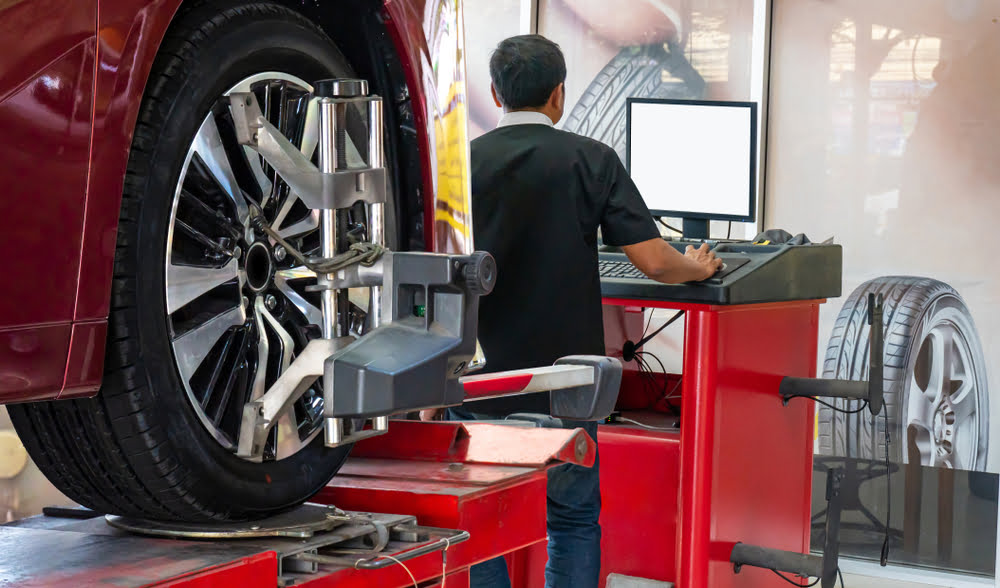
a mechanic sits in front of a computer with a tire alignment machine behind him, showing the difference between tire balancing vs alignment

If suspension issues aren’t fixed through a tire alignment, the car will become increasingly hard to handle and will begin to vibrate. This will take the tires down the road of no return because of inconsistent wear.

With that said, the cost of bad tire alignment your team may forget to share with customers is this. According to Investopedia, poor tire alignment reduces gas mileage by around 10%. If gas costs $4 a gallon, that’s a loss of $0.40 for every 20-30 miles a person drives. That can really add up.

Signs that a car needs a tire alignment include:

  • Veering
  • Tires squealing
  • Uneven or faster-than-expected tire wear
  • The steering wheel tilts to one side when driving if you’re not fully controlling it
  • Vibrating steering wheel, especially when speeding up

Tire balancing vs alignment maintenance recommendations are as follows. Your customers should get a tire balance every 5000-7000 miles (or based on manufacturer recommendations). Alignment should be checked that often but may not be needed every time. Tire alignment is typically done at least every two years or more if the vehicle shows signs of misalignment.

Type of Wheel Weights

Tire balancing vs alignment isn’t the only vs. decision to consider. There are several types of wheel weights and choices for you and your customers. Choosing the right type is essential to vehicle function. A poorly fitting weight could block the brakes or impact steering.

Adhesive vs. Clip-on. Clip-on wheel weights are placed correctly and then hammered to seal the clip. On the other hand, adhesive wheel weights have an adhesive strip you can remove and press down onto a clean surface. Some wheels have wheel flanges that aren’t deep enough for clip-on weights, making adhesive ones the only option.

P Type vs AW Type vs MC Type, etc. Another way wheel weights are categorized is rim gauge, with different letters representing the different rim gauge sizes on the vehicle’s make. For example, P Type is the most common for steel wheels. W Type is for Buick, Chevrolet, Chrysler, and Dodge, among others.

SVI International, Your One-Stop-Shop for Tire Changer Parts Solutions

As a leading tire changer part supplier, SVI International has everything you need to help your customer’s cars stay maintained, aligned, and balanced, like:

You can count on our unwavering commitment to excellence in product and service. To learn more, call us at +1(800) 321-8173 or fill out our quick contact form today.

When Is an Auto Bus Lift Required?

Due to the alternative vehicle dimensions, mechanics cannot effectively or safely utilize traditional auto lifts to service heavy-duty vehicles, including buses, semi-trucks, or trailers. Fortunately, multiple manufacturers designed a solution fit for larger vehicles and introduced the auto bus lift.

Are you wondering why or when one should use a bus lift? In the content below, we discuss the purpose of a heavy-duty bus lift, address when an auto bus lift is required, and explore three common types of auto bus lifts.

What Is the Purpose of a Heavy-Duty Bus Lift?

When dealing with any automotive vehicle, it is paramount to ensure proper use of vehicle lifts. Furthermore, it is unsafe to hoist a vehicle too large or too heavy for a standard auto lift.

Therefore, heavy-duty truck and bus lifts possess extraordinary quality and enhanced durability, complete with secure locking system. As a standard to heavy-duty regulations, most bus and truck lifts can hoist nearly 70,000 lbs.

When Is an Auto Bus Lift Required?

Essentially, your operation must utilize an auto bus lift when any heavy-duty vehicle needs servicing, maintenance, or cleaning tasks completed. To adhere to safety regulations within your auto shop, any non-standard vehicle (sedan, sports car, pickup truck, SUV, or minivan) requires a special auto lift that ensures a safe environment for you and your staff.

Therefore, whether you occasionally service a bus or complete maintenance on an entire fleet of trucks and buses, you must work with a heavy-duty auto lift.

Types of Bus Lifts

Before purchasing any type of car lift, it is imperative that you consider every aspect of both your current shop’s condition and what vehicles you intend to service. Assess your lift needs by answering the following questions:

  • What is your required load capacity? To safely operate any lift, we recommend purchasing a lift that exceeds your load capacity.
  • Do you have a specific lift height needed? Whether you need to raise a vehicle high for your mechanics or your shop has low ceilings, take the lift height into serious consideration.
  • How quickly would you like the lift to raise and lower the vehicle? While seemingly unimportant, consider how many times your mechanics raise and lower vehicles each day. Any opportunities to save time could generate a more productive workday.
  • How much power is required to hoist a vehicle? Determine how much psi your hydraulic system would need to supply to operate your lift effectively and safely.

Once you determine the need for a bus lift, you can then refine your selections based on your preferred model. Below, we discuss three common heavy-duty lift types that support multiple truck and bus vehicles.

power post auto bus lift front and rear

#1. In Ground – Front and Rear Bus Lifts

In-ground auto bus lifts, also known as power post lifting systems, prove extremely durable. With countless applications spanning from fire departments and municipal garages to airports and utility companies, these in-ground front and rear bus lifts range in heavy-duty lifting capacities. Below are two great models that cater to different weight classes.

2P-105-M

  • Lifting capacity: 24,000 lbs., 12,000lbs front and 12,000lbs rear
  • Single moveable front and single stationary rear
  • Axle engaging with modified narrow range rear saddle
  • Adjustable front cylinder for various wheelbase lengths
  • Air/hydraulic oil or Citgo “Aquamarine” oil operated
  • Post diameters: 10-5/8” front and rear
  • Displacement: 50 gallons
  • Lift height: 67” front and 69-3/4” rear based on standard adapters
  • Multiple lip seal design for increased performance

4P-106-IB

  • Lifting capacity at 250psi: 72,000lbs., 36,000 front and 36,000 rear
  • Lifting capacity at 350psi: 100,000lbs., 50,000 front and 50,000 rear
  • Axle engaging front saddle and adapters. I-Beam style rear superstructure equipped with adjustable saddles and adapters to engage vehicle axles, suspension, or cross frame member
  • Adjustable front cylinder for various wheelbase lengths
  • Electric/hydraulic oil or Citgo “Aquamarine” oil operated
  • Post diameters: (2) 10-5/8” front and (2) 10-5/8” rear
  • Lift height: 67” front and 69-3/4” rear based on standard adapters
  • Multiple lip seal design for increased performance
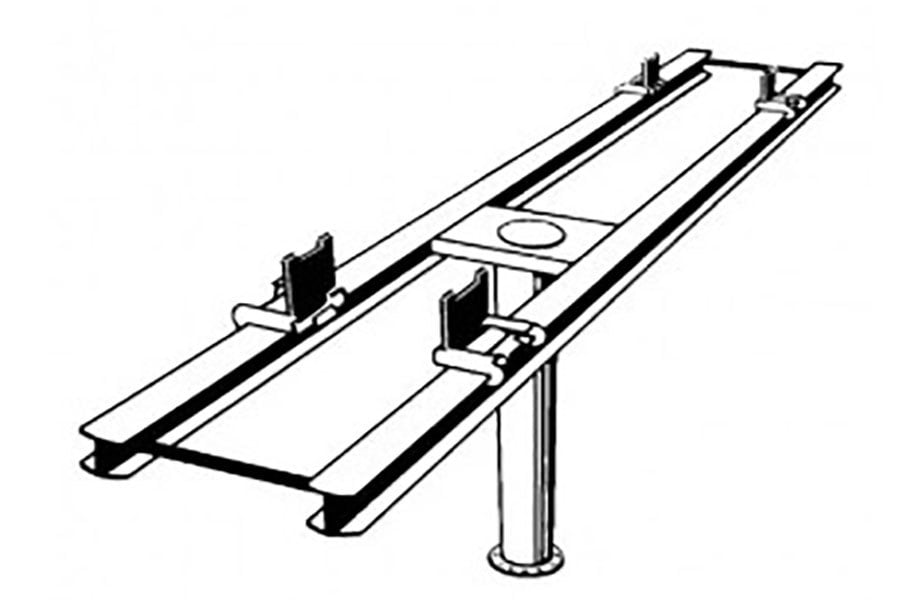
in ground single post bus lift

#2. In Ground – Single Post Bus Lifts

Single Post bus lifts are “multi-duty” free wheel lifts that offer an extra lifting capacity for passenger cars and light trucks. Therefore, your shop can efficiently operate on smaller buses and trucks in compliance with the below lift models and weight capacities.

LR-10

  • Cylinder Diameter: 10-5/8”
  • Center Load Capacity at 175psi: 12,000lbs., 6,000 front and 6,000 rear
  • Superstructure: 6” rails and 216” long
  • Lifting Height: 65”
  • Rail Length: 17’

LR-12

  • Cylinder Diameter: 10-5/8”
  • Center Load Capacity at 175psi: 15,000lbs., 7,500 front and 7,500 rear
  • Superstructure: 6” rails and 216” long
  • Lifting Height: 65”
  • Rail Length: 20’
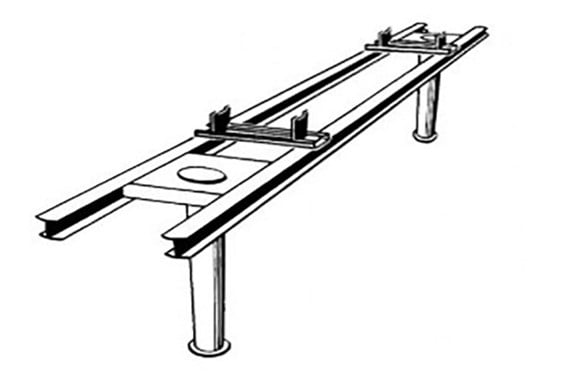
two post bus lift

#3. In Ground – Two-Post Bus Lifts

As another free wheel, recessed rail style lift, two post bus lifts offer twin connecting rails that accommodate all cars and trucks. As a result, your shop can utilize this lift type to service any vehicle type. Below are two popular two-post bus lift models that effectively cater to multiple bus, truck, and heavy-duty vehicle dimensions.

CR-210

  • Cylinder Diameter: (2) 10-5/8”
  • Center Load Capacity at 175psi: 24,000lbs., 12,000 front and 12,000 rear
  • Superstructure: 6” rails and 288” long
  • Lifting Height: 65”
  • Rail Length: 24’

CR-212

  • Cylinder Diameter: (2) 12-5/8”
  • Center Load Capacity at 175psi: 30,000lbs., 15,000 front and 15,000 rear
  • Superstructure: 8” rails and 360” long
  • Lifting Height: 65”
  • Rail Length: 30’

Find the Right Lifting Application at SVI International

Whether you are searching for a specific replacement part or are looking to find the best lifting solution for your auto shop, we are here to help. SVI International is the industry leader in automotive lifts and lift repair parts.

We provide over 40,000 repair parts for a plethora of lifts and brand-new auto lifts of extraordinary quality. SVI provides innovative solutions to solve industry challenges. If in need of a discontinued part, our expert mechanical engineers will design a cost-effective alternative solution for you.

Are you interested in learning more about our products or ready to request a quote? Contact us today at (800) 321-8173 or by submitting our online contact form.

Why Do I Need to Get My Car Lift Inspected?

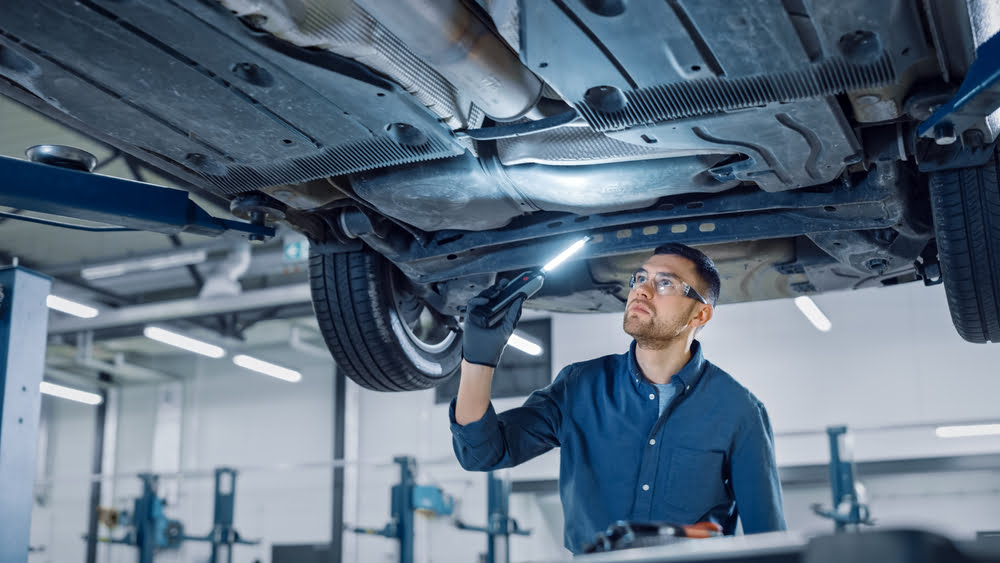
Man inspecting car lift

Car lifts are used in vehicle repair shops, car dealerships, and home garages. Depending on your needs, you can use a car lift to store your vehicle or lift your car for maintenance and repair.

As a mechanic, lifts are used constantly throughout the day to get underneath cars for necessary repairs. Over time, you will likely need to tighten a car lift’s bolts and pins, lubricate its posts, and tighten anchor bolts. In addition, you’ll need to check all the parts to ensure everything is in working order.

Car lifts need regular maintenance, like any mechanical equipment, to ensure continued safety. While monthly maintenance is recommended for any car lift, an annual inspection is critical for many reasons. 

What happens during an auto lift inspection? 

An auto lift inspector must confirm that all components are in working order and that your lift is safe. The Automotive Lift Institute (ALI) Lift Inspector Certification Program is the only independent certificate for lift inspector qualification in North America. While some may claim that their inspector can inspect lifts, choose one that is ALI certified. 

During an auto lift inspection, the ALI-certified inspector: 

  • Examines all accessible components for evidence of overloading or misuse
  • Checks the electrical wiring and components
  • Reviews the lift controls to ensure accessibility
  • Locates the safety instructions, lift safety labeling, capacity labeling, vehicle-lifting information, and any documentation
  • Verifies adequate clearances around the lift
  • Checks that all fastening devices are tight
  • Operates the lift and checks the operation of the positive stop
  • Verifies that the lift locks engage in the fully extended position
  • Checks all lubrication points for cleanliness and required lubrication
  • Checks all chains and cables for excessive slack

Every manufacturer provides specific instructions for correctly and thoroughly inspecting each lift. ALI inspectors are extremely qualified to inspect your lift, regardless of manufacturer. 

Benefits of an auto lift inspection 

An annual auto lift inspection by a certified lift inspector allows you to keep a safe working environment and your business in compliance, among numerous other benefits. 

Keeps a safe work environment 

Safety is the priority when a mechanic stands underneath a car weighing a minimum of 2,000 pounds. One minor issue with a lift can cause severe damage to the vehicle, the lift, and the mechanic. 

An annual auto lift inspection (at the very least) will ensure that your lift is safe and trustworthy and your work environment is safe for your employees. 

Identifies repair needs 

An annual inspection lets you identify repair needs before the issue becomes problematic. An inspector will review the lift from top to bottom and inspect every detail to ensure it’s in working order. 

Issues that arise will be noted so you can fix or repair the necessary parts. Using a car lift that hasn’t been appropriately inspected is a safety hazard to your employees and a liability for your business. 

Maintains employee trust 

Mechanics want to feel safe in their job, and standing underneath a vehicle that weighs at least 2,000 pounds is a significant risk. 

An annual inspection lets employees know that the car lift is safe and reliable, maintaining employee trust. 

Confidence for vehicle owners 

Vehicle owners will have confidence in mechanics who follow safety protocols for their working environment, including inspecting auto lifts. 

Vehicle owners take pride in their cars and don’t want to worry that the lift will malfunction while maintenance is done. A safe car lift provides confidence for customers. 

Stay on top of manufacturer-recommended timelines 

Every manufacturer has recommended timelines for maintenance and inspection. Following their specific recommendations keeps every part of the auto lift working in the best possible way. 

Extends the life of the lift 

If you let wear and tear affect your lift without inspection and repair, your car lift will not live a long life. 

However, an auto lift inspection allows a certified technician to inspect your lift, giving it a thorough workup. This complete workup allows everything to be tightened, greased, adjusted and fixed. 

An annual inspection extends the life of your auto lift. 

Keeps your business in compliance 

The American National Standard (ANSI), which outlines the safety criteria for proper vehicle lift operation, inspection, and maintenance, mandates that every lift be inspected at least once a year by a certified lift inspector. 

If you fail to meet these requirements, your auto lift will fail to comply with ANSI. Therefore, to keep your business in compliance, it’s required to have your car lifts inspected on an annual basis (at the very minimum). 

Peace of mind 

Nothing is better than peace of mind as a business owner, employee, or customer. An annual (at minimum) inspection of your car lift provides peace of mind to everyone- the mechanic standing under the lift, the customer whose vehicle is on the lift, and the owner responsible for the lift’s safety and operation. 

Lowers the risk of injuries 

Your employees are less likely to be hurt at work if you inspect your lift machines regularly. The inspector will check the emergency controls, steering, brakes, electrical systems, and hydraulic systems to ensure they are in good working order. The inspection also includes searching for physical problems such as corrosion, inspecting hooks for abnormalities, and determining the gauges’ accuracy. These actions lessen the likelihood of the device failing and causing an accident. 

Increases Productivity and Decrease Downtime 

Workflow is disrupted when lift equipment malfunctions, and some projects may have to be rescheduled. However, you can avoid mechanical breakdown with an annual inspection. Although the inspection process may seem lengthy, repairing the unit once it has completely failed will take far longer.

Contact SVI for your Parts and Maintenance Needs

Regular maintenance is the best approach to avoiding malfunctions and future difficulties. Should you need parts for your lift, SVI is here to help you. We have everything that you might need to stay safe and productive. Contact us today at (800) 321-8173 and we can offer you same-day shipping on in-stock parts!