
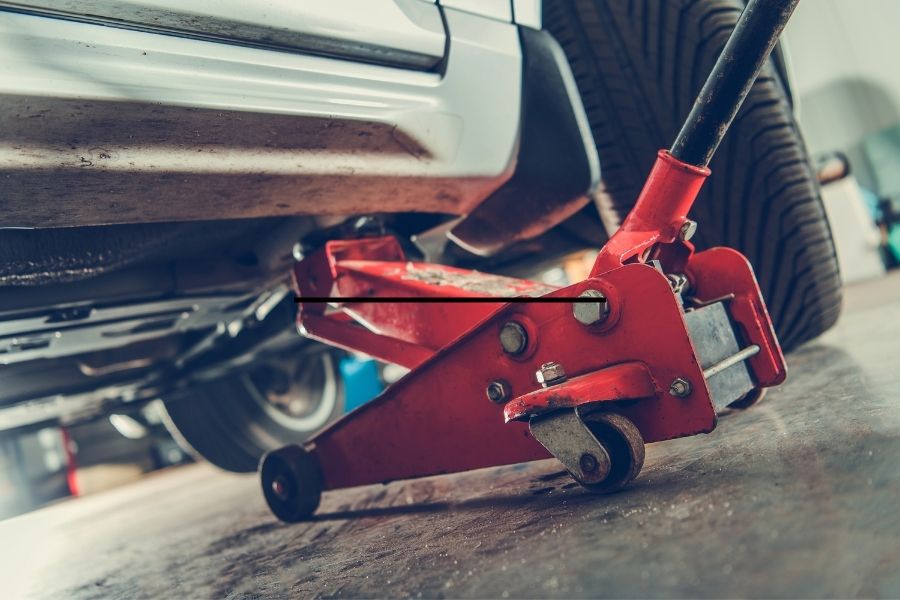
Floor Jack Repair: How to Fix a Floor Jack Not Lifting  

how to fix a jack that won't lift

You can have the best-equipped garage with the best tools in the world, but none of it will matter if you can’t get to the components of your vehicle that need to be fixed or replaced. A floor jack should be in your toolbox if you need to change your oil, replace a flat tire, or make other repairs to your car or truck.

Unfortunately, no matter which floor jack you choose, there might be a time when it doesn’t work like intended, and you’ll need to do some troubleshooting.

So, here is a handy guide for learning how to fix a jack that won’t lift.

How to Fix a Floor Jack Not Lifting

Confirm the Lift Capacity

It’s not always an issue with the jack; sometimes, it’s the sheer weight of the vehicle that you’re trying to lift.

Locate the Gross Vehicle Weight (GVW) on the sticker in your driver’s door jamb to find out the right tonnage capacity for your vehicle. The weight of most vehicles is also divided into front and rear weights. Make sure that the jack you purchase can lift more than the heavier of the two weights. For example, if you need 3100 pounds in the front (just over 1-1/2 tons), get a floor jack that can bear at least 2 or 2-1/2 tons.

Exercising a floor jack beyond its capacity stresses it, making the process dangerous for you.

Check Fluid Levels

One of the most common reasons a jack won’t lift is incorrect fluid levels. First, remove the oil plug and look into the chamber to check the oil level. The suggested level for most floor jacks is 3/16 to a quarter above the reservoir. If you need to replenish, make sure you have the highest-grade oil possible.

If the jack’s oil level is higher than the required level, you will need to drain it. When a jack has more fluid than necessary, it risks blowing out seals, producing internal leaks, and causing the jack to lose pressure.

A jack with a low oil level will generally work correctly, but the low fluid level will significantly reduce the jack’s height. Hydraulic systems are closed-loop, which means the fluid level should never fall below zero. If it does, there’s most likely a leak someplace, which you’ll need to rectify before using your jack.

Use only the hydraulic oil recommended by the manufacturer; using anything other, such as hydraulic brake fluid or transmission oil, could damage the seals.

Look for Trapped Air

A jack can be tilted during shipping, allowing air to enter the cylinders. As a result, when you first pull a new jack out of the box, it’s critical to bleed out the air before using it.

Additionally, it would be best to repeat this practice monthly or whenever you notice any lapses in lifting capacity. Bleeding the jack every month will help your jack perform at its best. To bleed your lift, follow the steps below:

With the valve open, pump ten times.

Close the valve and elevate it to the full height.

Continue to pump ten times while at full extension.

Lower the cylinder by releasing the valve.

If required, repeat two more times to expel all air from the cylinder.

Most of the time, this will completely bleed the jack. If not, gently pull the oil fill plug on the side after the cylinder has been freed and lowered to help remove any trapped air.

Test the Release Valve

If you’ve done everything above and it’s still not bearing pressure, you should check the release valve.

Check the valve for leaks and make sure it’s airtight. If it isn’t, it will let the pressure out and allow air back into the system when you try to raise something.

A leaking valve will almost always have a greasy coating around it, indicating a leak.

Routine Maintenance and Cleaning

It’s essential to do a comprehensive check-up even if you’ve been able to get the lift working by this point. Looking over all of the lift’s parts can prevent a future issue.

You should look for cracked welds, destroyed parts, oil leaks, and anything else that isn’t in working order. You should also check the jack’s ram by flipping it on both sides. Always inspect it in both the retracted and extended states. If the floor jack has rusty pistons, this could indicate a problem.

Regular inspections are necessary for your lift. For example, examine where the jack was stored for any fluid leaks and inspect the housing for any cracking or rust and the piston rod for scoring or other damage. You should also look to determine if excessive wear in any areas could cause problems. Finally, keep an eye out for any foreign things (metal shards, dirt, rocks, etc.) that could harm the device.

It’s also essential to clean the hydraulic jack after each use before storing it. Wash the jack’s exterior using a gentle soap solution. Make sure that you do NOT CLEAN the hydraulic components that move. Oil your parts regularly to avoid premature wear. It would be best to grease the caster wheels, the front axle, the elevator arm, handle base pivot bolts, and the release mechanism with a general-purpose lubricant. After each use, inspect the seals for possible oil leakage and replace them as soon as possible.

SVI International is the Leader Car Parts Dealer

Hopefully, this guide has helped you understand how to fix a jack that won’t lift. Regular maintenance is, once again, the most straightforward approach to avoiding malfunctions and future difficulties. Maintain your jack as much as possible by regularly keeping it clean and dry and lubricating it. Should you need parts for your lift or a new jack altogether, SVI is here to help you. We have everything that you might need for a safe and reliable floor jack. Contact us today at (800) 321-8173 and we can offer you same-day shipping on in-stock parts!

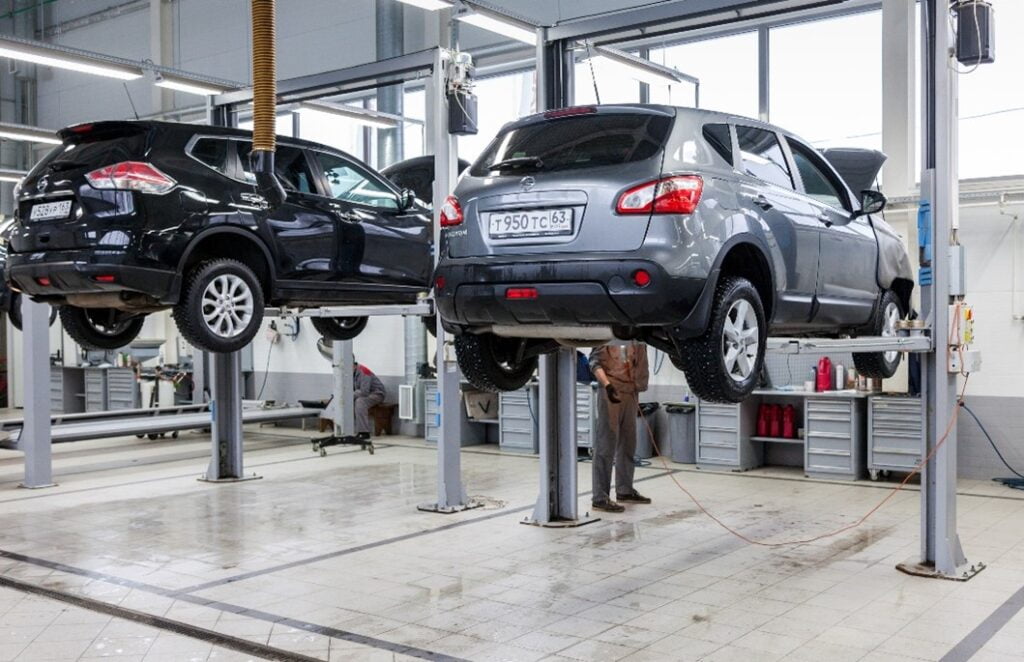
How to Position Your Truck on a 2 Post Lift 

Two post car lifts are among the most often used lifts worldwide. When used appropriately, they’re safe and dependable, and they can raise a lot of weight.

Two-post lifts align the car in the bay from front to back. The lift provides additional drive-through clearance since the columns are straight across from each other, facing each other. The vehicle’s and lift’s centers of gravity are aligned, distributing the load evenly across the columns, carriage, and bearings.

In addition, the two-post lift allows the operator to quickly reach all sections of the vehicle, including the wheel assemblies.

How Much Space is Required for a 2-Post Lift?

Auto lifts are frequently placed to align with either the entry door or the servicing bay in most garage spaces. When you have more area to work with, you can install the lift in a corner or at an angle, depending on how much floor space and clearance height you need.

It’s recommended to leave at least two feet of space between your posts, lifted cars, and the side walls. Otherwise, you will struggle while trying to maneuver around the vehicle while placed on the lift. Furthermore, you will not have enough room to readily remove wheels, axles, or tight nuts with a long pry bar.

Provide at least 12 feet between the lift posts and the back wall when installing symmetrical lifts. Allow at least 9 feet between the lift posts and the nearest wall if you plan to buy an asymmetrical lift.

A 2-post lift is great for trucks, vans, and commercial vehicles because of these advantages. Although popular and relatively easy to use, it takes a little skill. Below is a step-by-step guide for how to position your truck on a 2-post lift.

How to Position Your Truck on a 2 Post Lift

Double-check Safety and Capacity

Before using your car lift, check the weight capacity to ensure that you are not attempting to move a truck that the lift cannot handle. Also, make sure your car lift is ANSI/ALI ALCTV-2011 or ANSI/UL 201 certified.

Clear the Space

To begin, remove any obstacles from the area. The space necessary for a 2-post lift includes a larger area with open entry ports. The surface should also be flat, with no bumps or slopes, as this can cause an accident.

Position the Vehicle

Place your truck between the lift columns in the proper location. Refer to the guide for positioning the automobile relative to the spotting dish. Confirm that the vehicle is properly positioned in the middle of the lifting podium. On both sides, the lifting posts should be symmetrical.

Put your car in park and use the emergency brake if you have an automatic transmission for additional safety. For manual transmission, put the car in first gear and apply wheel chocks on the back wheels.

Choose Correct Adapters

Examine the adapters to ensure they are tall enough to establish simultaneous contact with the lift points. Some trucks may require special height adapters to provide more room between the lift arm and the rocker panel.

Some height adapters have stacking pegs that connect to one another, giving the lift pad extra height and allowing it to stay on top of the rocker panel or frame.

In certain circumstances, a special truck adapter or frame cradle pads might be needed.

Position the Arms

Place the lift pads under the correct lift points. Then, raise the reclining swing arms to the manufacturer’s recommended lifting point under the vehicle. When you stretch the swing arms on most new model cars, an arrow directs you to the spot where the adapters should be placed. This spot is the starting location for the lift. You can reach the lifting points with extensions, which provide additional grip while also leveling the automobile during elevation.

Before starting to rise, confirm that the lift pads are correctly seated and locked.

Test the Lift

Examine the area for any obstacles before pressing the power button to elevate the vehicle. Next, activate the lifting unit and allow it to raise the car slightly above the ground. Once the wheels are roughly six inches off the ground, check to verify if they are level. Then try swaying the vehicle from the front or back to determine if it’s stable. If the truck bounces on the pads or feels otherwise unsteady, lower it to the ground quickly and reposition the pads as needed.

Make any necessary modifications after double-checking to ensure that lift contact is even and accurate.

When lifting, make sure the safety locks engage click after click, and remember to disengage them when the truck comes down.

Raise the Truck Fully

You can then lift the automobile to the desired height once you’ve ensured that it sits securely on the pads and isn’t swaying. Again, consult your owner’s handbook for the maximum allowed height that a truck can be raised on a two-post lift.

When lifting, make sure the safety locks engage click after click, and keep in mind that they’ll have to be disengaged as the truck is delivered. Before going beneath the vehicle, lower the lift to the locked position once you’ve reached the desired height.

Lowering the Vehicle

Before you lower the truck back to the ground, be sure there is no one or anything underneath it.

Release the lift’s safety locks and lower the vehicle gradually.

Finding the Right 2-Post Lift

Finding a dependable lift supplier with high-quality items doesn’t have to be complicated.

SVI International is committed to excellence. We provide 40,000 repair parts from 50 product lines as industry leaders in automotive and industrial equipment repair parts. Our products are distributed across three warehouses across the country, allowing for quick and reliable delivery.

We encourage you to contact us today if you seek specialty lifts. Call (800) 321-8173 or use our online form to contact us right now. We look forward to helping you with your auto lifts!

What Kind of Hydraulic Fluid Does a Car Lift Use

If you have an automotive shop, or just enjoy working in your garage, then a car lift is likely the focal point of your workspace.  A car lift allows you to quickly work on the vehicles and keep a constitute stream of happy customers, or to enjoy working on your fun automotive projects in your garage.

Just like how you enjoy taking care of vehicles, it is also important to take care of your car lift. A car lift, just like any other piece of machinery, needs proper maintenance to run smoothly and efficiently. In fact, a majority of the car lift’s ability to operate comes from its cables and hydraulic fluid level. In order to make sure your car lift stays in top shape, it is important to make sure your car lift is properly lubricated at all times. When wondering what kind of hydraulic fluid does a car lift use, we have these answers and more to keep your equipment working safely and properly. At SVI International, we have all the automotive parts you may need to make sure your car lift stays in top shape.

How to Choose the Best Hydraulic Oil

You may be shocked to know many areas of your car lift needs to be lubricated.  For example, many two-posts car lifts need lubrication of their inside corners and latch shafts in order to continue to run smoothly. Lubricating your car lift and maintaining the proper hydraulic fluid level ensures your car lift will not malfunction, causing long waiting lines or, even worst, injured vehicles or persons.  As such, choosing the right lubricant is essential to upkeeping your car lift.

To start, lubricant and grease are not the same things. “Lubricant” implies a liquid, while “grease” implies a solid. As a general rule, always select the car lift lubricant suggested by your car lift’s manufacturer. This information can be found in your car lift manual, or you may be able to locate the information by calling the manufacturer’s number or through a simple google search by typing in your car lift’s information online. If you speak with a manufacturer, most will recommend a few different types of hydraulic oils which can be used on their lifts. Below are two of the recommended types of hydraulic oil to help you choose the best car lift to lubricate for your two-post car lift, four-post car lift, four-post roller jacks, pro-jacks, or a mid or low-rise car lift:

  1. The first brand is called “AW”. AW is short for anti-wear. This is a great type of hydraulic oil for your car lift. First, it protects your car lift from any rust and, or oxidation. Second, it contains anti-foam additives. Specifically, there are two versions of AW available for your use: AW32 and AW46. AW32 is a 10-weight oil after the additives are added. AW46, on the other hand, is a 15-weight oil after the additive is added. Both AW 32 and AW46 are blended with very refined naphthenic/paraffinic base oils. What is great about AW is that you receive all the advantages of a premium hydraulic oil, but at a much lower price point than a hydraulic oil of similar standards. AW32 or AW46 can be used anytime a premium AW product is not specifically called for.
  2. The second brand is referred to as “R & O.” R & O is short for rust and oxidation. Similar to the AW products above, R & O contains anti-foaming additives. As such, the weight of R & O is 10 weight oil after the additives are added. R & O is appropriate when premium R & O is not otherwise specifically called for.

You can purchase any of these above types of hydraulic oil from your local automotive store.

Per the usual course of maintaining your car lift, you will also need to lubricate your car lift’s chains. As you use your car lift, sand, dirt, dust, and other debris can get stuck inside your car lift’s chains – thus greatly reducing the life and integrity of the chains. For cleaning your car lift’s chain, a spray lubricant is best in this situation. To clean your car lift’s chains, first lower the car lift. You do not want any pressure on the chains when cleaning. Next, simply spray the chain and wipe it down.

How Often Should You Replenish Hydraulic Fluid Levels

First and foremost, you should perform a monthly check of your entire car lift to make sure it is functioning correctly and does not pose a danger to any person or vehicle. Concerning the hydraulic fluid level, also check this about once a month, and fill it in accordance with your car lift manual. Regarding your car lift’s chains, the frequency which you should check these depends on the environment in which you live. Although these will be checked during your monthly check, a lift that is in a dusty, dry environment will need to be lubricated more often than a car lift that is not in such an environment.

SVI is Here to Help

Just like you enjoy taking care of cars, you need to take care of your car lift. By making sure your hydraulic oil is at the correct level, and properly lubricating the car lift’s chains, you can take care of your car lift so, in turn, you can take care of your customers. At SVI, International, we have the automotive parts your car lift needs to stay in top shape. Contact us today to get the parts you need to keep your car lift functioning smoothly.

Questions About Hydraulic Oil for Lifts

Does hydraulic fluid come with lifts?

In short, no. Current restrictions in place essentially require that the required hydraulic fluid can only be supplied by the end-user.

What is the difference between AW32 and AW46 hydraulic oils?

AW32 and AW46 differ in their weights. AW32 is 10, at times called ISO32, and AW46 is 15, at times called ISO46.

What is the most recommended hydraulic oil by lift manufacturers?

Most manufacturers will recommend AW32 and AW46 due to their anti-wear, protection against rust and oxidation, and anti-foaming properties.