Symmetric vs Asymmetric Lift: Which is Best
At some point in the automotive lift discovery process, individuals in the market often overhear the terms “asymmetrical” and “symmetrical,” usually in the same sentence as “two-post.” If this describes you, excellent!
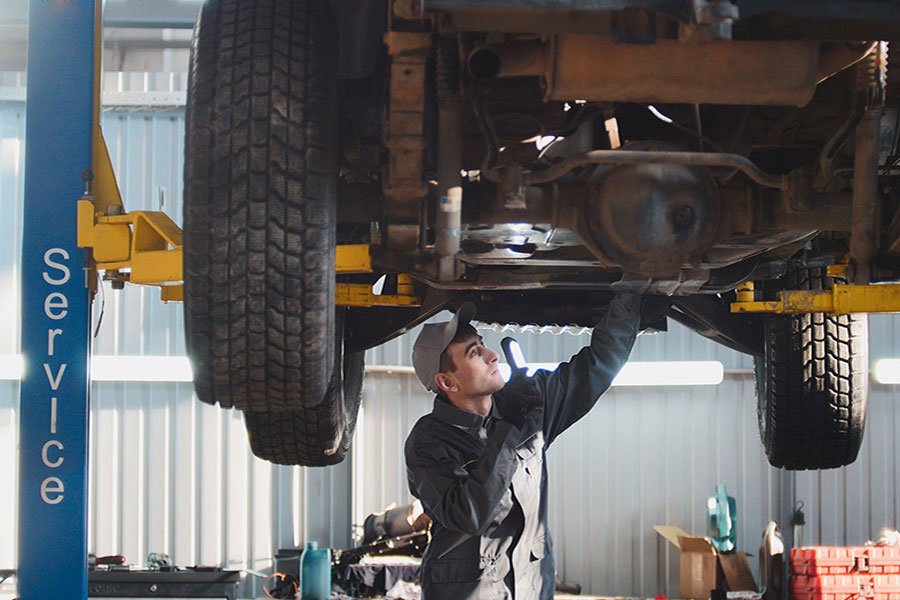
Asymmetrical and symmetrical lifts are two-post lifts, and determining which best fits your application begins with a comparison of both. In the content below, we will overview two-post lifts before comparing symmetric vs asymmetric lifts.
Two-Post Lift
Determining which specific lift, asymmetrical vs symmetrical lift, is best for your application begins with an understanding of two-post lifts in general.
Firstly, two-post lifts are incredibly common, found in most auto repair shops, especially drive-in stops. Vehicle enthusiasts with automotive repair knowledge may install a two-post lift in their personal garage for easy access. Two-post lifts are frame-engaging, meaning they use four adaptable arms to hoist vehicles at specific lifting points on the undercarriage. One primary reason for two-post popularity is range of use. Due to lifting capability, technicians and enthusiasts can easily perform undercarriage repair, including engine and transmission work.
Because two-post lifts are frame-engaging, access to the undercarriage is even possible in low-ceiling garages. Inevitably, two-post lifts are among the most ideal for a shop with a low ceiling. Two-post lifts are often used for light truck, van, and car repair, with a maximum lifting capacity of about 20,000 pounds, depending on the lift. Finally, two-post lifts are most often anchored to the ground during installation. If you plan to keep your lift sedentary, this aids in durability for long-term use.
Symmetrical vs Asymmetrical Lifts
Symmetrical and asymmetrical lifts are some of the most common two-post lift options. Either type is ideal for repairing light trucks, vans, and standard vehicles. However, there are some important differences between the two that you’ll need to take into account when comparing an asymmetrical vs symmetrical lift.
Asymmetrical Lift
Simply put, asymmetrical lifts refer to the column or arm configuration of the lift. Asymmetrical lifts were designed to solve a problem in old, symmetrical lift variations. When in-ground and above-ground symmetrical lifts were installed next to each other the symmetrical lifts would encroach on the space, especially in an average lift bay. In response, many major lift manufacturers reduced the width between the columns – ultimately, creating a new problem. Vehicles barely fit inside the lift. Entering and exiting was difficult, cars were easily scuffed during work, and technicians struggled to complete projects. The solution: asymmetrical lifts.
Asymmetrical lifts feature shorter front arms and longer back arms for easy access. Before lifting, the four lift arms would be moved away from the vehicle. Technicians move the vehicle forward, until about 30% of the vehicle sat in front of the column while 70% sat behind. The shorter arms are positioned to specially designated lift points first, followed by the longer, rear lift arms. Asymmetrical lifts are created with heavy-duty rear arms to support the majority of the vehicle’s weight. Along with heavy-duty back arms, manufacturers rotated both columns 30 degrees, so the posts are angled outward while facing each other.
Ultimately, the asymmetric configuration solves the original issues. The driver’s front door opens wider, allowing for access into the vehicle, under the vehicle, and smooth transfer from the lift to the floor and vice versa.
Pros of Asymmetrical Lifts
Asymmetrical lifts allow you to access the inside of a vehicle with ease, as the vehicle is placed slightly to the back of the lift rather than right at the center. What’s more, they’re ideal for specialized service work such as transmission repair/replacement and bodywork repair.
Cons of Asymmetrical Lifts
Asymmetrical lifts take up more space, require more regular maintenance, and operate more slowly than symmetrical ones.
Symmetrical Lift
As mentioned, most original two-post, above-ground lifts were entirely symmetrical. Symmetrical lifts feature four arms of equal lengths and two columns directly facing each other. Thus, the vehicle is positioned directly between the two posts, equally split 50% on both sides. On a symmetrical lift, pressure is equalized on the lift’s posts and carriage, designed to lift the vehicle in the middle. As compared to its asymmetrical counterpart, symmetrical lifts allow to a wider drive-through area, often utilized for pick-up trucks, vans, and wider vehicles or vehicles with a weighted rear.
Pros of Symmetrical Lifts
Symmetrical lifts tend to have a higher weight capacity than asymmetrical ones. Because the vehicle is centered on a symmetrical lift, the lift can operate quickly and efficiently. Symmetrical lifts are durable and dependable, and it’s easy to maneuver around a vehicle on one of these lifts.
Cons of Symmetrical Lifts
Symmetrical lifts are more expensive than asymmetrical ones. Furthermore, the design of a symmetrical lift may make it difficult or even impossible to use certain tools in a repair, maintenance, or parts replacement job.
Other Less Common Two-Post Lifts
Symmetrical and asymmetrical lifts are by far the most common options. However, there are also two other model options. These are the semi-asymmetrical lift or a versymmetrical lift.
The semi-asymmetric lift has short front arms and long rear arms. It enables you to access certain parts of a vehicle easily; however, its design puts a lot of wear and tear on the bearings.
A versymmetrical lift is a combination of a symmetric and asymmetric lift. It is designed to allow an auto shop owner to use the lift in either capacity, as the need arises. Some models get high reviews, but many don’t work as well as either a symmetrical lift or an asymmetrical one.
Versymmetrical
Semi-Asymmetrical
Semi-asymmetrical lifts feature shorter front arms than rear arms; however, both center columns face each other directly.
To get in touch, contact our team today at (800) 321-8173 or via our online contact form!
We must mention a third, if less popular, variation of two-post lifts – because you may have heard the name. In theory, versymmetrical automotive lifts are the ideal combination of asymmetrical and symmetrical lifts. For example, the columns might face directly, but the arms may be asymmetrical. Versymmetrical lifts receive mixed reviews; some manufacturers declare versymmetrical lifts combine the worst aspects of asymmetrical and symmetrical lifts, a sort of hideous Frankenstein monster.
Cons Associated in Both Asymmetrical & Symmetrical Lifts
While asymmetrical and symmetrical lifts are both commonplace, they share a few cons that you’ll want to be aware of when making a purchase.
Door Protection
Both asymmetrical and symmetrical automotive lifts poise the risk of denting vehicle doors. This reality is unescapable. Even if technicians are extraordinarily careful, accidents happen. Thus, regardless of the two-post lift you choose, extra precaution should be taken to protect vehicle doors. DoorJammer car door protection is an excellent option. Specific benefits include:
- Elimination of costly damage (door dents, scratches, etc.), reduced stress, and the prevention of lost revenue.
- The device is trustworthy, award-winning, with a design patent.
- The product is fashioned with impact and energy absorbing foam.
- Technicians find it easier to enter and exit vehicles on hoists shielded with car door protection.
- Utilizing the product can also improve the appearance of your shop.
- The items are stocked and ready to ship immediately from one of SVI’s three cross-country warehouses.
Space Requirements
Any two-post lift will need a clearance of at least 12 feet from floor to ceiling. Asymmetric lifts should be at least 9 feet from a wall. Symmetric lifts should be installed about 12 feet from a wall.
Maintenance Requirements
Both lift types will need preventative maintenance and periodic inspections. You’ll also need to be on the lookout for common lift problems such as high temperatures, failure to prime, and knocking sounds.
In addition to training your employees in lift repair and maintenance, you’ll also want to have a reliable lift part supplier with a large stock and fast shipping. That’s why auto shops around the country turn to SVI for lift components. Our large stock, two ready-ship warehouses, and high standard of customer service make it easy for you to find any part you need, when you need it. Get in touch with us to learn more about our services, find information about a part, or place an order.
Two-Post Repair Products
Regardless of the age of your lift – decades old or brand new – SVI International provides the repair parts required to extend the life of your auto lift. Among the items available for two-post lifts, SVI carries:
- Overhead stop limit components
- Equalizer and lifting cables and chain
- Power units and parts
- Lift installation and relocation supplies
- Auxiliary height extensions
- Rubber arm pads
- Complete lift arm assemblies and components
- Lift arm pins
- Arm restrain/ lock assemblies and parts
- Slider blocks and bearings
- Carriage locks and components
- Hydraulic cylinders
- Hydraulic seal kits
- Pulleys and sheaves
Any repair part you may require, SVI International has in in stock, ready to ship, or ready to craft by our fully degreed mechanical engineers.
Asymmetrical Lift and Symmetrical Lift at SVI International
At SVI International, we are passionate about solutions and innovation. As the leader in repair parts for automotive and industrial equipment, quality, shipment speed, and problem solving define our company. We are spread across the country with 3 warehouses, 40K repair parts, 50 product lines, and 2K distributors. For your company, we are the “can-do” solution.